Bronze Industrial Design Excellence Award – 1995
AWARD: BRONZE – Industrial Design Excellence Award, 1995
An annual product design competition sponsored by the Industrial Designers Society of America and Business Week Magazine.
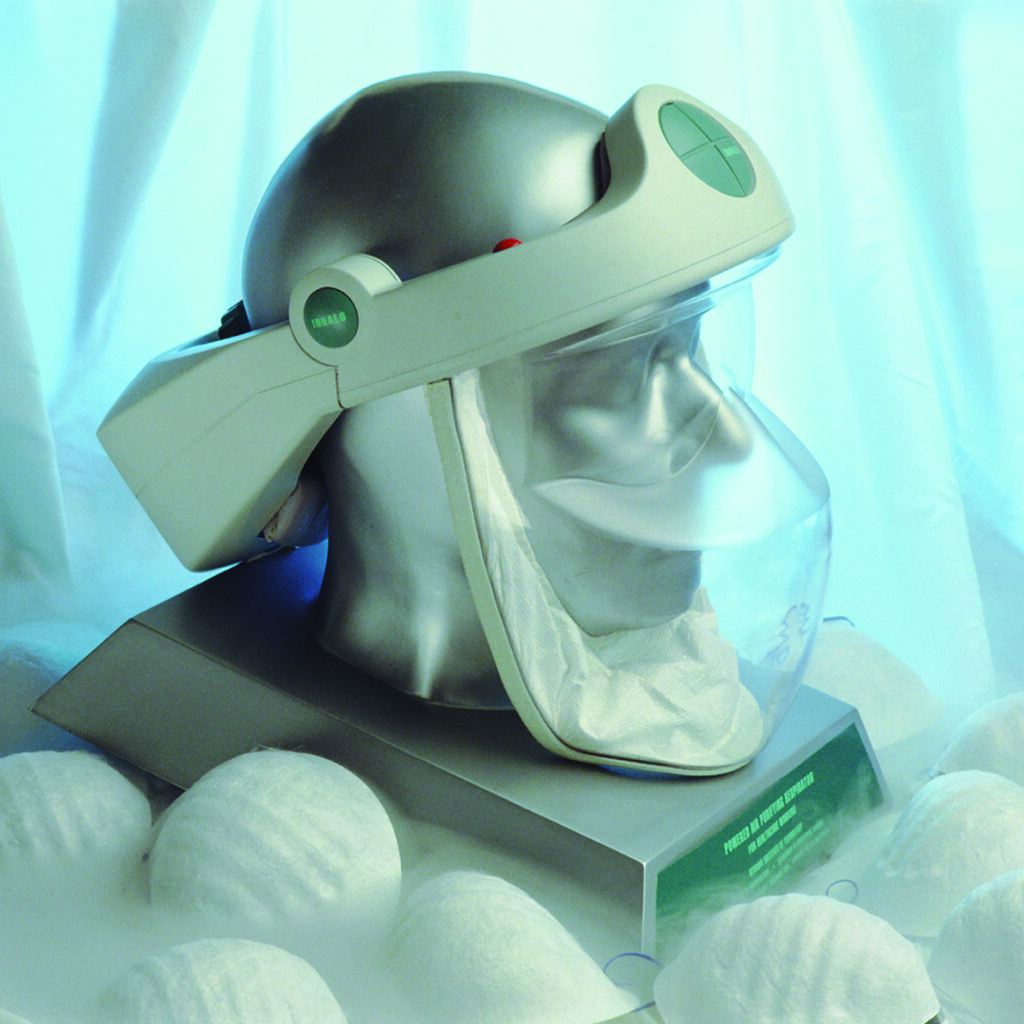
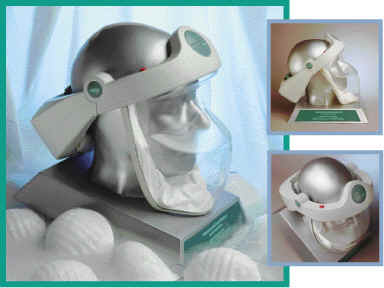
Medical Air-Purifying Respirator for the Healthcare Environment
“An investigation into the problems associated with providing personal respiratory protection in healthcare and the development of a proposed design solution.”
Prepared by Mr. Willis Whiteside – Master’s Student (1993–1995), Georgia Institute of Technology, Georgia Tech – School of Industrial Design.
Industrial Design and Product Development Thesis
This industrial design and product development master’s thesis involved designing a lightweight, battery-powered, positive-pressure, loose-fitting respirator. The respirator uses a high-efficiency particulate air (HEPA) filter.
Tuberculosis and Airborne Respiratory Protection
Tuberculosis (TB) is an airborne disease that can spread through coughing or sneezing. Viable tuberculosis bacilli become aerosolized as droplets and may remain airborne for hours.
Healthcare workers who work in close proximity to infectious patients are exposed to TB.
Providing medical air-purifying respirator protection against airborne infectious diseases, such as TB, remains a serious and growing challenge.
The threat of a TB epidemic intensified with the emergence of multidrug-resistant TB strains. These strains did not respond to available drug treatments, resulting in a reported 60% cure rate.
NIOSH Respiratory Protection Recommendations
NIOSH proposed requiring the use of a powered air-purifying respirator (PAPR) equipped with a high-efficiency particulate air (HEPA) filter. This was recommended over negative-pressure dust or fume masks.
However, these masks were typically designed for mining, industrial applications, and firefighting.
They were large, black, and bulky. Their appearance resembled a firefighter’s protective equipment rather than that of a caretaker attending to a dying patient.
Healthcare Worker Safety, Comfort, and Patient Care
The real-world problem was that alternative protective devices, including paper and HEPA-filter masks, met most technical requirements.
However, they failed to address important safety, comfort, and occupational issues associated with caring for infectious TB patients.
The thesis examined the challenges of controlling the spread of TB and other airborne diseases. Its purpose was to develop a better respiratory protection solution for healthcare providers.
Final Product Design and Human Factors
The final product design’s appearance was inspired by the symbolism of an angelic “halo.”
It considered the physical, human factors, psychological, and social aspects of the patient-caretaker relationship.
The project also included a 105-page written thesis supervised by three thesis advisors.
Research Reference
U.S. Department of Health Services, Centers for Disease Control, National Institute for Occupational Safety and Health, Atlanta, GA. NIOSH Recommended Guidelines for Personal Respiratory Protection of Workers in Healthcare Facilities Potentially Exposed to Tuberculosis. September 1992, p. 13.
Credits and Gratitude
Mr. William (Bill) Bullock, Senior Advisor
Georgia Tech Department Head, Industrial Design Department
Mr. Len D. Singer, Advisor
Georgia Tech Professor, Industrial Design Department
Mr. David I. Jacobi, Advisor
Georgia Tech Master’s – Human Factors Department
Mr. Paul Hiltman, Technical Advisor
ISI Corporation, Lawrenceville, GA
Mrs. Debbie Whiteside
Ms. Linda Forman
Mr. Mel Hutto
Mrs. Carolina Gill
Mock-Up Photography Model
Mr. Doug Purvis
Purvis Photography