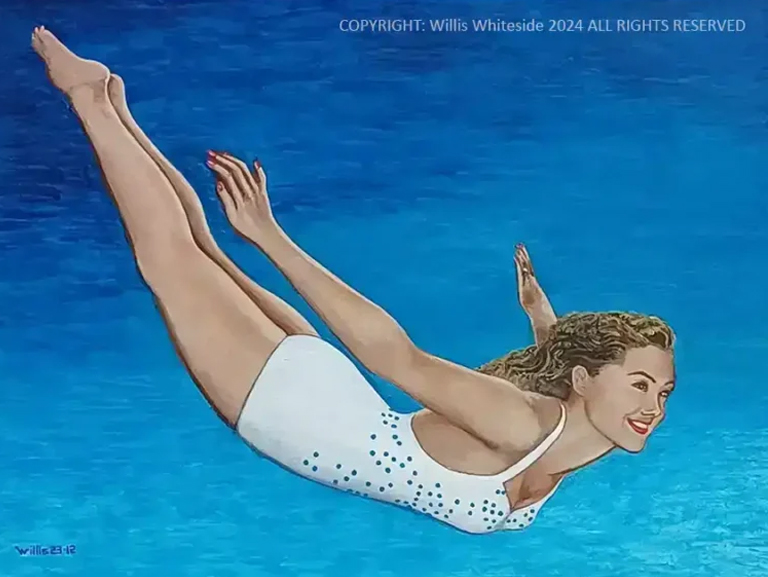
Esther Jane Williams (August 8, 1921 – June 6, 2013)
Swimming Career and Early Achievements
American competitive swimmer and actress famed as MGM’s “Million Dollar Mermaid.”
Esther Williams set regional and national records in her late teens while swimming for the Los Angeles Athletic Club swim team.
By age 16, Williams had won three U.S. national championships in breaststroke and freestyle swimming.
In 1939, she was part of the record-setting 300-yard medley relay team. Additionally, she became the national AAU champion in the 100-meter freestyle, recording a time of 1 minute, 9.0 seconds.
Olympic Dreams and Aquacade Performances
Williams’s dreams of competing in the 1940 Summer Olympics were sacrificed because of World War II.
Instead, she joined Billy Rose’s Aquacade, swimming alongside Olympic gold medalist and Tarzan star Johnny Weissmuller (1904–1984).
During the 1940s and early 1950s, Williams performed elaborate synchronized swimming and diving routines known as “aquamusicals.”
Hollywood Film Career
After achieving bathing suit pin-up status, Williams launched her film and acting career alongside Mickey Rooney (1920–2014) in an Andy Hardy film.
She also appeared with future five-time co-star Van Johnson (1916–2008) in A Guy Named Joe.
From 1946 to 1954, Williams had at least one film among the 20 highest-grossing films of the year.
Her film career included starring as Australian swimming star Annette Kellerman (1887–1975) in Million Dollar Mermaid.
Following her film success, Williams appeared in popular water-themed network television specials, including Cypress Gardens, Florida.
Film Popularity and Box Office Rankings
Appearing in more than 30 films, Williams was voted among the country’s most popular film stars by U.S. movie exhibitors.
1947: 24th most popular star.
1948: 11th most popular star.
1949: 8th most popular star.
1950: 8th most popular star and 2nd most popular star in the United Kingdom.
1951: 5th most popular female star.
1952: 12th most popular star.
1953: 12th most popular star.
1954: 25th most popular star.
Business Ventures and Swimming Endorsements
After retiring from acting, Williams became a successful businesswoman.
She invested in a bathing suit manufacturer, various businesses, and properties, including a restaurant chain known as “Trails.”
Additionally, Williams endorsed a line of swimming pools, retro swimwear, and instructional swimming videos for children.
Olympic Commentary and Hollywood Recognition
Williams served as a synchronized swimming commentator at the 1984 Summer Olympics in Los Angeles.
The motion-picture industry awarded her a star on the Hollywood Walk of Fame at 1560 Vine Street.
On August 1, 1944, she left her handprints and footprints in front of Grauman’s Chinese Theatre.
Synchronistically looking up! w2
Copyright: Willis Whiteside 2023. All Rights Reserved.
Back to the GOAT Art Gallery
REFERENCES: https://en.wikipedia.org/wiki/Esther_Williams