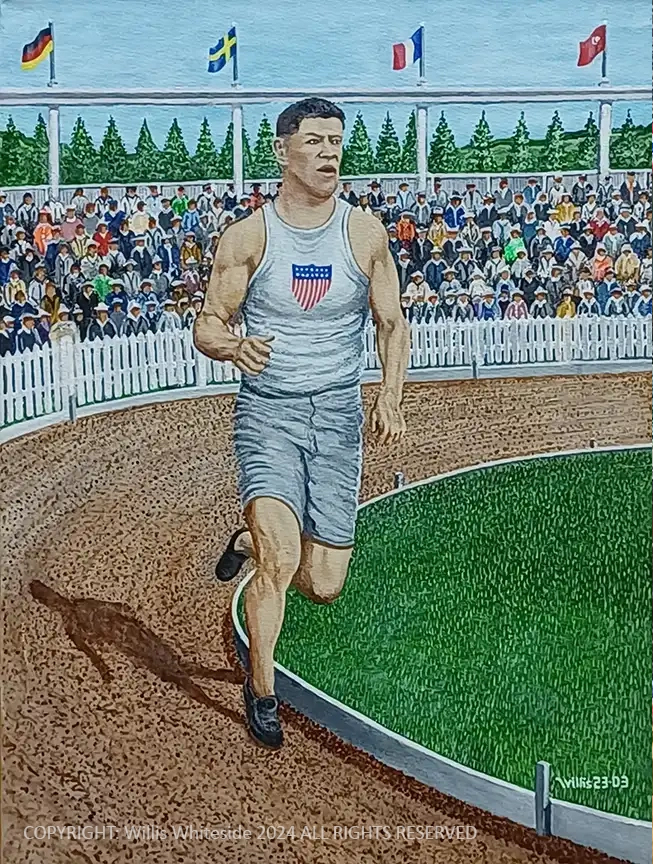
Jim Thorpe (1887–1953, Aged 70)
James Francis Thorpe Wa-Tho-Huk, translated as “Bright Path” (Sac and Fox Nation), Oklahoma.
Considered one of the most versatile athletes of modern sports!
Early Life and College Athletics
At Carlisle Indian Industrial School in Pennsylvania, Thorpe became a two-time All-American football player under coach Pop Warner (1871–1954).
His achievements in 1907 included track and field, football, baseball, lacrosse, and ballroom dancing. The intercollegiate ballroom dancing championship followed in 1912.
Throughout his career, Thorpe played collegiate and professional football, baseball, and basketball.
Four field goals by Thorpe contributed to an 18–15 upset of top-ranked Harvard. With an 11–1 season in 1912, Carlisle won the national collegiate championship.
1912 Olympic Gold Medals
The 1912 Summer Olympics took place in Stockholm, Sweden, where Thorpe competed.
As the first Native American to win two gold medals for the United States, he claimed victories in the five-event pentathlon and ten-event decathlon.
Of the 15 events, Thorpe won eight.
Someone stole his shoes just before the competition. As a result, he ran in a mismatched pair, including one from a trash can, and won the gold medal.
Olympic Medal Controversy and Restoration
In 1913, the International Olympic Committee (IOC) stripped his medals for violating amateurism rules after receiving room and board while playing summer baseball.
Thirty years after his death, the IOC restored his Olympic medals and titles in 1983.
By 2022, Thorpe was relisted as the sole champion in both events.
Professional Baseball and Football Career
From 1913 to 1919, Thorpe played six seasons with the New York Giants.
The Canton Bulldogs football team welcomed him in 1915, and he helped them win three professional championships.
His positions included running back, defensive back, placekicker, and punter.
Although full records are unavailable, reports credit him with 27 touchdowns and 224 points during the season, rushing 191 times for 1,869 yards.
Football Leadership and Recognition
As the first president of the American Professional Football Association, Thorpe led the organization that became the NFL in 1922.
The Associated Press (AP) ranked him as the “greatest athlete” from the first 50 years of the 20th century.
In 1963, he was inducted into the Pro Football Hall of Fame as part of its inaugural class.
Jim Thorpe, Pennsylvania, was named in his honor.
Film Appearances and Olympic Honors
Throughout his life, Thorpe appeared in several films. Burt Lancaster portrayed him in the 1951 film Jim Thorpe – All-American.
During the 1912 Olympics, he also received two challenge prizes. King Gustav V of Sweden donated the decathlon prize, while Czar Nicholas II of Russia donated the pentathlon prize.
Presenting his prize, King Gustav said, “You, sir, are the greatest athlete in the world.”
Thorpe replied, “Thanks, King.”
Looking Up to Bright Path… w2
Copyright: Willis Whiteside 2023. All Rights Reserved.
Back to the GOAT Art Gallery
REFERENCES: https://en.wikipedia.org/wiki/Jim_Thorpe