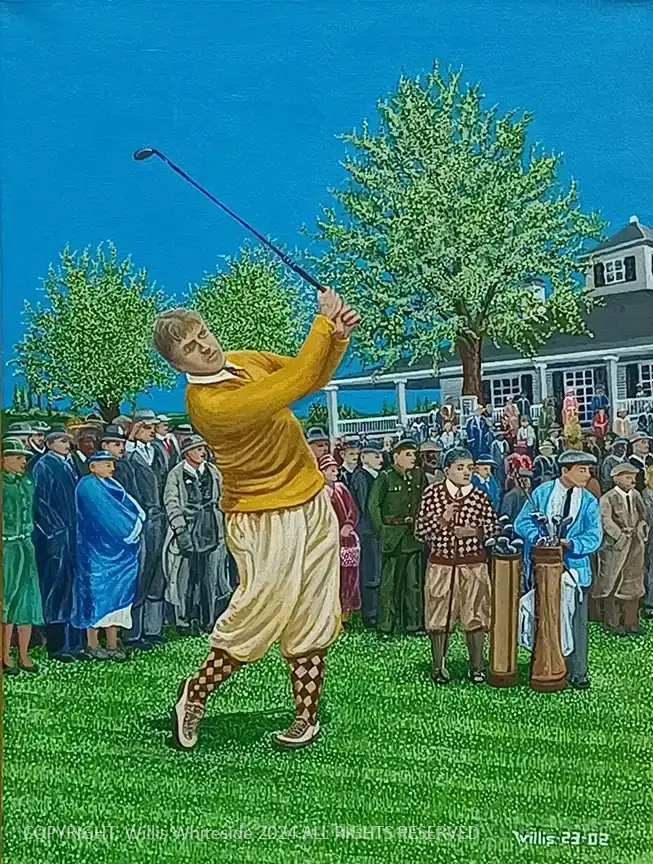
Robert (Bobby) Tyre Jones Jr. (1902–1971)
Atlanta, GA | 5’8″ | 165 lbs.
Golf Career and Professional Achievements
One of the most influential and innovative figures in amateur golf history, Bobby Jones competed from 1923 to 1930. He retired at age 30 and worked as a lawyer, course designer, instructor, and equipment designer.
Jones earned degrees from Georgia Tech, Harvard, and Emory University in Atlanta, Georgia.
At the height of his career, he excelled against top-level amateur competition. He also competed against the world’s best professional golfers, including Walter Hagen (1892–1969, aged 76) and Gene Sarazen (1902–1999, aged 97).
Jones founded and helped design Augusta National Golf Club in Georgia. Additionally, he co-founded the Masters Tournament.
Early Golf Career
At age six, in 1908, Jones won his first children’s tournament at his home course, East Lake Golf Club.
In 1916, at age 14, he won his first major golf event, the inaugural Georgia Amateur Championship. The Georgia State Golf Association conducted the tournament at Capital City Club in Brookhaven, GA.
Sportsmanship and International Competition
Known for his good sportsmanship, Jones took penalties in several tournaments, sometimes costing him the victory.
He also represented the United States for the first time, winning two international amateur team matches against Canada.
The 1930 Grand Slam
In 1930, Jones achieved his “Grand Slam,” winning all four major golf tournaments. These included the Open and Amateur Championships in both the United States and the United Kingdom.
Throughout his career, Jones competed in 31 major championships, winning 13 and finishing among the top ten 27 times.
He was the second and last golfer to win the U.S. Open and U.S. Amateur in the same year. Chick Evans first accomplished this achievement in 1916.
Tournament Wins
- 1908 East Lake Children’s Tournament, East Lake Golf Club. (Age 6)
- 1911 Junior Championship Cup of the Atlanta Athletic Club
- 1915 Invitation Tournament at Roebuck Springs
- Birmingham Country Club Invitation
- Davis & Freeman Cup at East Lake, East Lake Club Championship
- Druid Hills Club Championship
- 1916 Georgia Amateur, Birmingham Country Club Invitation* (Age 14) * 1st major golf event
- Cherokee Club Invitation, East Lake Invitational
- 1917 Southern Amateur
- 1919 Yates-Gode Tournament
- 1920 Davis & Freeman Cup at East Lake
- Southern Amateur, Morris County Invitational
- 1922 Southern Amateur; 1923, 1926, 1929, 1930 US Open
- 1926, 1927, 1930 The Open Championship
- 1924, 1925, 1927, 1928, 1930 US Amateur
- 1930 British Amateur, James E. Sullivan Award, 1934 13 Masters Tournaments (Tied)
- 1958 Georgia Tech Athletic Hall of Fame
- 1974 World Golf Hall of Fame
- 1997 Georgia Tech Engineering Hall of Fame
Bobby Jones inspired many young and professional golfers to pursue their dream of mastering the greens! The Augusta National Golf Club and the annual Masters Tournament with the ceremonial green jacket are considered the pinnacle of course design, landscaping, and golfing achievement.
FORE !!!…. w2
Copyright: Willis Whiteside 2023. All Rights Reserved.
Back to the GOAT Art Gallery
REFERENCES: https://en.wikipedia.org/wiki/Bobby_Jones_(golfer)