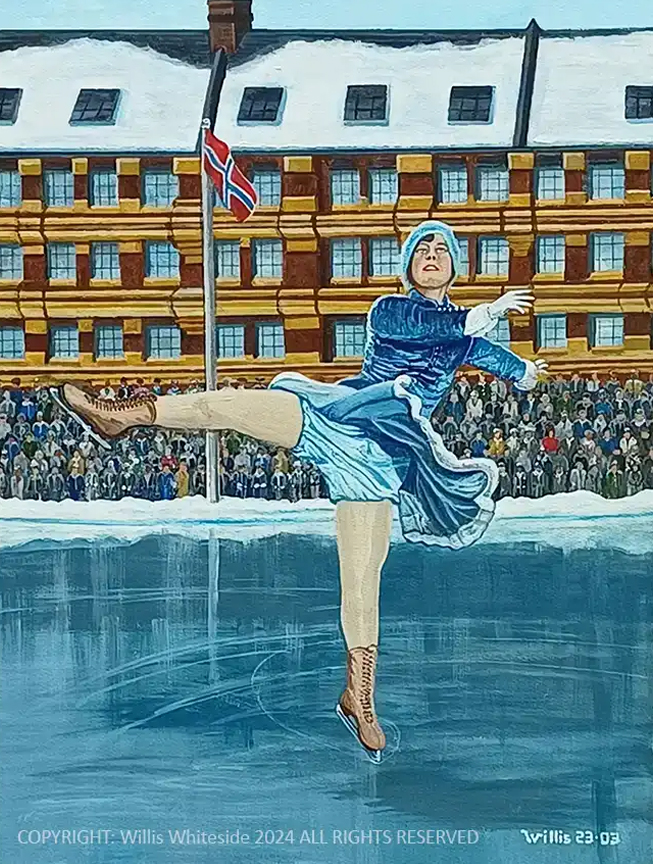
Sonja Henie (1912–1969)
Sonja Henie (aged 57, plane crash) was a prolific figure skater and film star. She was also one of the most successful women in the world during her time.
Olympic and World Championship Achievements
A three-time Olympic champion (1928, 1932, 1936) in women’s singles, Henie was also a ten-time World champion (1927–1936) and six-time European champion (1931–1936).
In 1938, at age 25, she became the youngest person to be made a Knight First Class of the Royal Norwegian Order of St. Olav.
Henie won more Olympic and World titles than any other women’s figure skater. Her six European titles have only been matched by Katarina Witt.
Early Figure Skating Career
At age 10, Henie won her first major figure skating competition, the senior Norwegian championships, in 1923. At age 11, she placed eighth in a field of eight at the 1924 Winter Olympics.
In 1927, at age 14, Henie won her first World Figure Skating Championship. The following year, she earned the first of her three Olympic gold medals, becoming one of the youngest Olympic figure skating champions.
She defended her Olympic titles in 1932 and 1936. Additionally, she continued winning annual World titles through 1936.
Hollywood Film Career
In Hollywood, Henie starred in a series of box-office hits. These included Thin Ice (1937), Happy Landing, My Lucky Star (1938), Second Fiddle (1939), and Sun Valley Serenade (1941).
Her first film was One in a Million (1936). She also skated in films such as Second Fiddle (1939) and Sun Valley Serenade (1941), featuring Glenn Miller and John Payne. Her movies grossed over $100 million.
Happy Landing (1938) was her biggest box-office hit.
Ice Shows and International Tours
From 1938 to 1943, Henie produced the touring ice show Hollywood Ice Revue. These lavish theatrical musical ice skating shows sold millions of tickets at Rockefeller Center’s Center Theatre.
In 1950, she presented the Sonja Henie Ice Revue. Her 1953 European Holiday on Ice tour was a great success, followed by shows at the Roxy Theatre in New York in 1956.
Final Years and Lasting Legacy
Before her passing in a plane flying from Paris to Oslo, Henie was planning a television comeback. The program would have aired in 1970, featuring her skating to “Lara’s Theme” from Doctor Zhivago.
In 1976, Henie was inducted into the World Figure Skating Hall of Fame. In 1982, she was inducted into the International Women’s Sports Hall of Fame. She also received a star on the Hollywood Walk of Fame.
Sonja was skating for all! …w2
Copyright: Willis Whiteside 2023 All Rights Reserved.
Back to the GOAT Art Gallery
REFERENCE: https://en.wikipedia.org/wiki/Sonja_Henie